When I was a boy in the early 1960s, my sister and the civil rights struggle taught me about fairness. My sister always insisted on candy and comic books being shared equally with her and our little brother—I could never convince her I should have more because I was older or male. And Florida’s segregated schools, which claimed to be "
separate but equal" while giving far more to white schools than black ones, showed me there's no equality without equal resources.
Fairness may be simple for children because they don't have power and therefore don't have to rationalize it, but some adults say some people deserve more than others—and then they define "deserve" in a way that includes them. My favorite answer to that is from
Hamlet: "Use every man after his desert, and who should 'scape whipping?
If the world's wealth were shared today, each adult on the planet would have money and possessions equal to $43,800 US. If the world's income were shared, over the coming year, each person, regardless of age, would get $10,500. In that world, Emma and I would have a shared wealth of $87,600 and a shared income of $21,000. If we had children, each child would add $10,500 a year to our household. Since we don't have children, by the end of the year, we would expect our combined wealth and income, excluding expenses, to be $108,600.
Which is about what we're looking at for 2012.
Which makes us richer than we've ever been.
And as rich as everyone could be.
*
We never planned to live in a fair world. For most of our life together, we've lived very simply. We're writers, and only the best-selling few manage to become rich. For the last six years, we were the caretakers at an artist's retreat, which meant we lived cheaply in a beautiful place, and though we were poor, we knew we were lucky to be able to do what we loved.
Then my sister died unexpectedly, leaving us enough to pay our debts and have almost exactly what we would in a fair world.
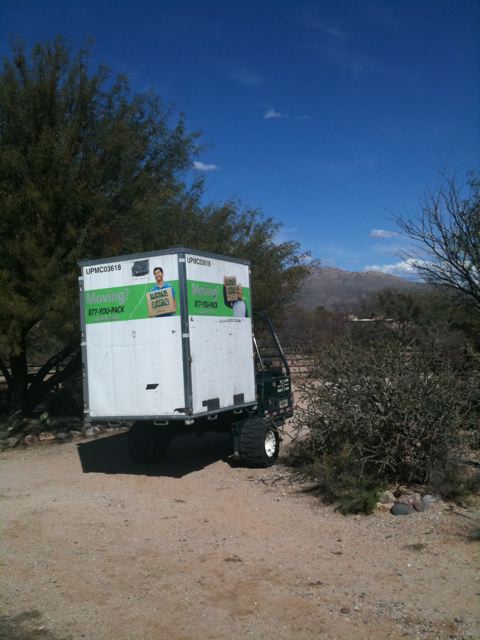
So we loaded our worldly goods into a small moving pod:
(photo by Ellen Kushner)
And we drove our twelve-year-old Toyota Echo to Minneapolis, where we bought a 700-square-foot house for $75,000.
*
Now, when I say everyone could have as much as Emma and I currently do, I'm not arguing that fairness requires perfect economic equality. Everyone's needs are different. But the logic of fairness calls for a small gap between the richest and the poorest. A
survey by Michael I. Norton and Dan Ariely compared the distribution of wealth in the US with what Americans think it is and what they think it should be. Most Americans think the richest 20% should own 32% of the country's wealth; today, the richest 20% own 84%. Most Americans think the poorest 20% should own a little over 10% of the country's wealth; today, the poorest 20% own 0.1%.
I'm also not suggesting that our lives this year will be a perfect model of what life would be like in a fair world. We're in the United States, where health care and education cost much more than anywhere else—a better model of life in a fair world would be set in a country like Norway or Canada.
But we have to begin where we are.
*
It's impossible to anticipate every objection I might get, but I'll take on one now:
Some people will say that having a fair share of the wealth is a privilege. Their objection comes from something valid: in a world where the rich take so much, few people get their fair share. But privilege is not the absence of oppression. Privilege requires having more than your fair share. You may argue that privilege begins when you have a penny more or a million dollars more, but there's no privilege in having what everyone could. In this world, there's only luck.
And in our case, it was a very hard form of good luck. I will miss my sister until I die.
*
Soon: All about our finances. An intimate look at how close Emma and I come to living in a fair world.
*
Recommended reading:[PDF]
Global Wealth Report - Credit Suisse eMagazineMapping Global Wealth | OtherWordsWho Rules America: Wealth, Income, and PowerIt's the Inequality, Stupid | Mother JonesThe Real Wealth of US Households by the Numbers | Daily ReckoningBy the Numbers: A Closer Look at the Real Wealth of US Households | Daily Reckoning